Equipping Students for a Billion-Dollar Global Economy
The global educational landscape is undergoing a profound and irreversible structural shift, moving decisively away from archaic, industrial-era pedagogical models towards dynamic, technology-integrated learning ecosystems. At the absolute vanguard of this transformation is the integration of competitive digital athletics, commonly known as eSports, into formal academic curricula. As the global economy accelerates into the 5th Industrial Revolution (5IR), an era defined not merely by the automation and interconnectivity of the 4th Industrial Revolution, but by the seamless, purposeful, and ethical collaboration between advanced digital systems and human cognitive agility, the fundamental imperative for education has evolved. Schools must now pivot from knowledge retention to dynamic, Real-World Readiness.
This exhaustive research report provides a granular analysis of the explosive financial growth of the global eSports industry, currently projected to surpass the $4.5 billion mark in 2026. Furthermore, it comprehensively elucidates how strategic participation in this sector equips students with an indispensable, highly transferable matrix of skills. Through an in-depth examination, this report highlights how Centennial Schools strategically leverages state-of-the-art infrastructure, comprehensive wellness frameworks, and elite industry partnerships to position its students at the absolute forefront of this digital frontier, systematically replacing traditional instructional methods with modern Learning Hubs that foster innovation, leadership, and elite digital literacy.
The Global eSports Economy: Exponential Market Growth and Revenue Dynamics
The eSports sector has definitively transcended its origins as a niche digital subculture, maturing into a central, dominant pillar of the global entertainment, media, and technology economy. Comprehensive market analytics for the 2024–2030 forecast period demonstrate a trajectory of unprecedented fiscal expansion, driven by increasing global digital connectivity, the rapid proliferation of high-fidelity live-streaming platforms, and fundamental demographic shifts in media consumption habits among younger generations.
Macroeconomic Valuation and Longitudinal Revenue Projections
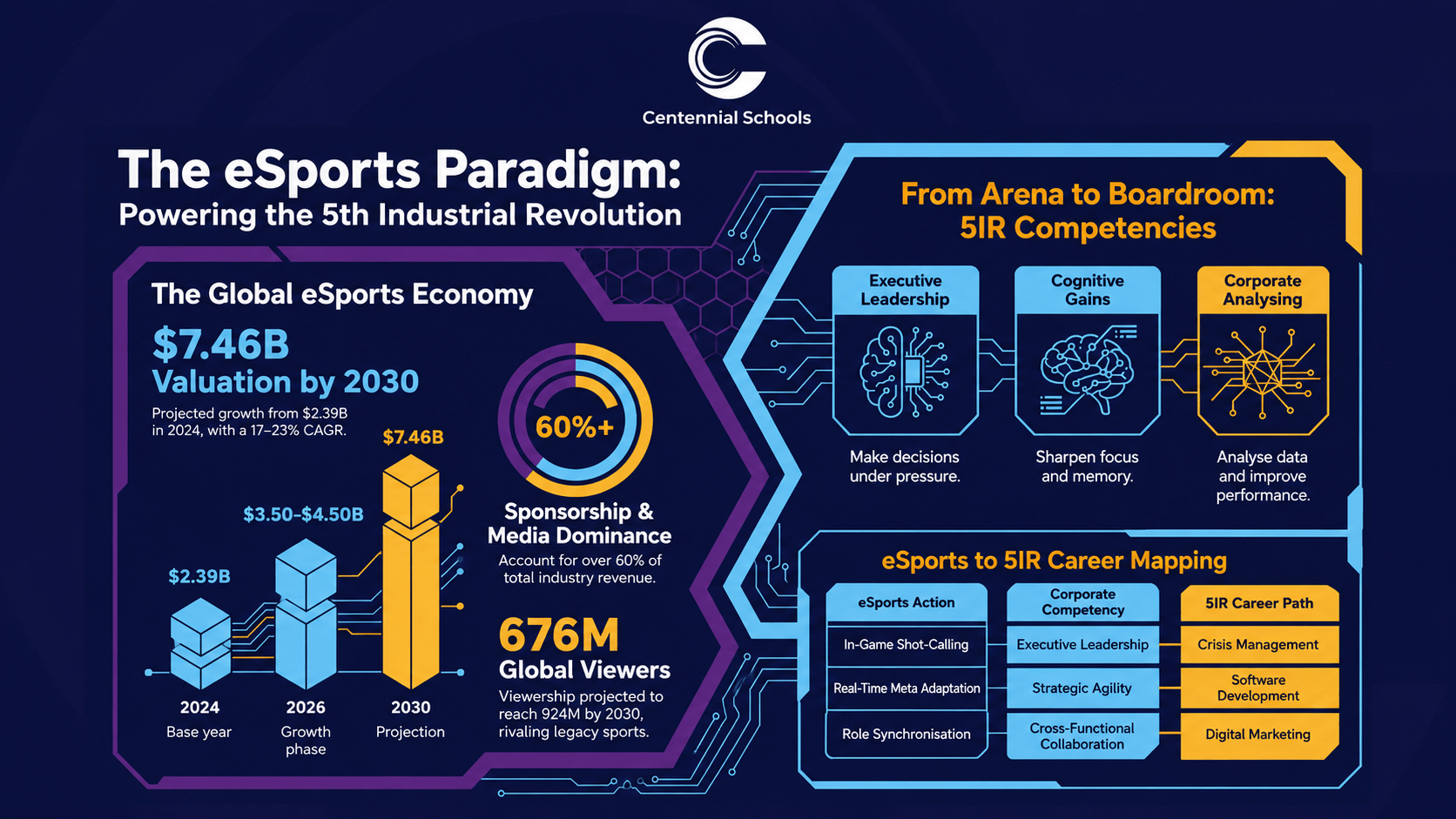
The global eSports market has experienced robust, sustained year-on-year growth, climbing from an estimated base of $2.13 billion to $2.39 billion in 2024, to a projected consensus of $2.89 billion by the end of 2025.1 Current financial models indicate that the market is poised to generate between $3.5 billion and $4.5 billion in gross revenue during the 2026 fiscal year, contingent upon the inclusion of ancillary revenue streams such as regulated digital wagering.1
Looking towards the horizon, long-term economic projections highlight the undeniable sustainability and entrenchment of this digital ecosystem. The market is forecasted to reach approximately $7.46 billion by 2030, representing a compound annual growth rate (CAGR) of between 16.87% and 23.1%, depending on the specific econometric model applied.2 Even more aggressive longitudinal studies suggest that the broader eSports and interactive digital media market ecosystem could surge beyond an astonishing $55 billion by 2035, underscoring the absolute permanence of digital athletics within the global economic framework.5
| Financial Year | Estimated Market Value (Consensus Minimum) | Estimated Market Value (Consensus Maximum) | Year-on-Year Growth Rate | Key Market Drivers |
| 2024 | $2.13 Billion | $2.39 Billion | ~10% | Post-pandemic digital retention, initial infrastructure scale.1 |
| 2025 | $2.89 Billion | $4.80 Billion | 14% – 20% | Mainstream broadcasting integration, hardware advancements.1 |
| 2026 (Proj.) | $3.50 Billion | $4.50 Billion | 12% – 21% | Expanded sponsorship portfolios, global tournament scaling.1 |
| 2027 (Proj.) | $4.20 Billion | $5.11 Billion | ~20% | Web3 integration, decentralised media rights distribution.1 |
| 2030 (Proj.) | $7.46 Billion | $10.00 Billion | CAGR 17–23% | Total generational shift in entertainment consumption.2 |
| 2035 (Proj.) | $55.41 Billion (Broad Market) | – | CAGR 21.19% | Omnipresent 5IR integration, simulated reality events.5 |

Revenue Stratification: The Complex Ecosystem Beyond Publisher Fees
Understanding the intricate economic architecture of eSports is vital for adequately preparing students for the myriad careers existing within it. The industry is emphatically not sustained solely by consumer game sales or developer tournament fees. In 2026, corporate sponsorship and strategic advertising represent the single largest revenue stream, projected to account for between $950 million and $1.2 billion roughly 35% to 42% of total non-betting revenue.1
This metric highlights a crucial macroeconomic insight: the eSports industry requires a massive, highly skilled workforce of marketing professionals, brand managers, public relations experts, and partnership executives to sustain this capital influx. Media rights contribute a further $500 million to $600 million, while streaming revenues, direct ticketing, and specialised merchandising make up the remainder of the core revenue blocks.1 The diversification of these income streams vividly illustrates the vast array of professional ecosystems surrounding the digital arenas. Students engaging with comprehensive eSports programmes are not merely training to be professional players; they are entering a multifaceted digital economy that demands sophisticated expertise in event management, intellectual property law, live broadcasting, and digital commerce.
| Core Revenue Stream (2026 Projections) | Estimated Value Range (USD) | Percentage Share of Total | Primary Required Workforce Skills |
| Sponsorship & Advertising | $950M – $1.2B | 35% – 42% | Brand management, digital marketing, B2B sales.1 |
| Media Rights | $500M – $600M | ~25% | IP law, broadcasting negotiation, contract management.1 |
| Streaming Revenue | $150M – $200M | 5% – 7% | Content creation, community management, algorithm optimisation.1 |
| Tickets & Merchandise | $100M – $130M | 3% – 5% | Supply chain logistics, event operations, retail management.1 |
| Game Publisher Fees | Variable by Title | ~12% | Software engineering, game design, competitive balancing.6 |
Audience Engagement and Global Regional Dominance
The audience for competitive gaming has reached staggering, unprecedented proportions, rivalling and frequently exceeding the viewership of traditional legacy sports. By 2026, the global eSports audience expanded to an estimated 676 million viewers worldwide, comprising roughly 335 million dedicated, highly engaged fans and over 320 million occasional viewers.1 This captive audience is projected to grow to over 924 million by 2030, representing a fundamental paradigm shift in how younger demographics consume entertainment.3
Geographically, the Asia-Pacific (APAC) region remains the dominant economic force, accounting for a massive 57% of global viewership and roughly 48% of total revenue generation.1 This is heavily driven by deeply entrenched mobile gaming markets and significant governmental and corporate infrastructure investments in China and South Korea.1 North America follows as a highly lucrative, high-yield market, capturing over 30% of the revenue share due to high-value corporate sponsorships and premium media rights agreements.2
However, emerging markets represent the vital next frontier for industry expansion. Regions such as Africa and South America are witnessing an exponential surge in grassroots engagement, mobile penetration, and targeted infrastructure investment.7 Facilities like the Centennial Schools eSports Arena in Johannesburg, South Africa, are pioneering this expansion, ensuring that local students are not merely passive consumers in this global market, but active, highly skilled, and technologically fluent participants capable of competing on the international stage.8
The 5th Industrial Revolution (5IR) and Educational Paradigm Shifts
To properly contextualise the strategic importance of eSports within a modern schooling framework, one must first comprehend the macroeconomic and societal shifts driven by the 5th Industrial Revolution. While the 4th Industrial Revolution (4IR) was characterised primarily by the rise of automation, artificial intelligence, big data, and the Internet of Things (IoT), 5IR represents a critical return to human-centricity.10 It focuses intensely on the synergistic collaboration between highly capable, autonomous digital systems and human emotional intelligence, creativity, ethical frameworking, and complex moral reasoning.10
The Obsolescence of Traditional Schooling Architectures
Traditional educational models, characterised by rigid classrooms, rote memorisation, standardised testing, and a monotonous “chalk-and-talk” delivery method, were engineered specifically to produce compliant workforces for the agrarian and early industrial eras. These systems are fundamentally incompatible with the fluid, highly complex demands of the 5IR economy. When statistical analyses suggest that up to 80% of the careers current primary school students will enter do not yet exist, teaching children strictly what to think rather than how to adapt, analyse, and iterate is an unmitigated educational failure.14
A thoroughly re-engineered learning landscape is required. Education must aggressively evolve to include digital technologies natively, fostering environments where students are not passive receptacles of outdated information, but active co-creators of knowledge, capable of leveraging advanced technological tools to solve real-world problems.12
The Centennial Schools Philosophy: Absolute Real World Readiness
Centennial Schools was explicitly established to address and rectify this exact educational deficit. Founded by educational visionary and seasoned entrepreneur Shaun Fuchs, the institution operates on an uncompromising philosophy of “Real World Readiness,” deliberately eschewing traditional school clichés and outdated pedagogical methodologies.14 The physical environment reflects this pedagogy with striking clarity: traditional classrooms have been entirely abolished and replaced by modern, dynamic Learning Hubs. These spaces are intentionally designed to foster high-level collaboration, physical mobility, and organic peer-to-peer interaction, mirroring the environments of elite global technology firms.14
This educational model integrates 5IR principles deeply into the curriculum at every developmental stage. It recognises that technical proficiency must be perfectly balanced with holistic human development. The school’s Future-Ready framework prioritises critical thinking, advanced digital skills, and entrepreneurial studies, acknowledging that navigating the modern world requires a seamless synthesis of robust academic foundations and advanced technological fluency.14 In this context, eSports serves as the perfect pedagogical crucible, acting as a live, interactive laboratory where human strategy, rapid decision-making, and teamwork intersect with high-performance computing..
Transferable Skills: The Pedagogical Value of Competitive Digital Athletics
The integration of eSports into a formal academic environment is not a capitulation to youth entertainment preferences; it is a highly calculated, strategic pedagogical tool. Extensive academic research, neurobiological studies, and industry analyses unanimously confirm that competitive gaming cultivates a distinct, highly valuable set of transferable skills, both cognitive and interpersonal, that map directly to the stringent requirements of the modern corporate workspace and the broader 5IR economy.
Cognitive Enhancement and Measurable Neurobiological Benefits
Contrary to outdated, moral-panic narratives that reflexively vilify video gaming, contemporary neurobiological research reveals significant, measurable cognitive benefits associated with structured digital play. A comprehensive, landmark study supported by the National Institutes of Health (NIH), which analysed data from the Adolescent Brain Cognitive Development (ABCD) Study involving nearly 2,000 children, demonstrated that students engaged in regular video gaming performed measurably better on cognitive skills tests involving impulse control and working memory compared to non-gamers.19
Further academic research highlights that the fast-paced decision-making required in complex, real-time strategy games or multiplayer online battle arena (MOBA) environments significantly improves peripheral perception, anticipation timing, and overall neural activity patterns.20 In essence, the high-stakes, rapid-information processing environment of eSports serves as high-intensity interval training for the adolescent brain, sharpening the exact analytical skills that are directly applicable to STEM fields and complex problem-solving scenarios in the real world.22 The American Psychological Association further supports this, noting that video games foster substantial cognitive, motivational, emotional, and social benefits.23
Strategic Thinking, Agility, and Complex Problem-Solving
In the rigorous context of competitive eSports, students are routinely subjected to high-pressure scenarios requiring the immediate triage of overwhelming amounts of visual and auditory information. Games such as League of Legends, Overwatch, or Valorant present players with constantly shifting variables, incomplete data sets, and unpredictable human opponents. To achieve success, students must employ advanced strategic thinking, rapidly analysing incoming data, reading opponent behavioural patterns, and adapting their tactical approach in real-time.8
This continuous, high-speed cycle of testing hypotheses, experiencing immediate failure or success, and rapidly iterating on strategy builds a profound level of cognitive resilience and adaptability.22 It systematically teaches students that failure is not a permanent terminal state, but rather a vital data point required for future success, an iterative mindset that is absolutely essential for modern entrepreneurship, scientific inquiry, and technological innovation.22

Interpersonal Dynamics: High-Stakes Communication and Collaborative Leadership
The outdated stereotype of the isolated, anti-social gamer is entirely incongruent with the reality of modern eSports. Today’s digital athletics are deeply social, intensely collaborative, team-based endeavours. Effective, precise communication is the primary differentiator between amateur enthusiasts and elite competitive teams. In the chaotic heat of a competitive match, players must deliver concise, accurate, and immediately actionable intelligence to their teammates over voice communication networks.25
This environment necessitates high emotional intelligence and the vital ability to remain perfectly calm under extreme pressure.26 “Shot-calling”, the specific act of making split-second tactical decisions for the entire team and communicating them with authority, develops formidable leadership skills.8 Furthermore, managing intra-team conflict, fostering morale after a critical setback, and negotiating roles within a squad build the exact collaborative competencies and social-emotional learning (SEL) skills demanded by modern, cross-functional corporate environments.25
| eSports Mechanic / Action | Corresponding 5IR Corporate Competency | Practical Real-World Application |
| In-Game “Shot-Calling” | Executive Leadership & Crisis Management | Directing project teams under tight, high-pressure deadlines.8 |
| Real-Time Meta Adaptation | Strategic Agility & Problem Solving | Pivoting business strategies in response to sudden market disruptions.24 |
| Post-Match VOD Review | Data Analysis & Quality Assurance | Conducting post-mortem project reviews to identify inefficiencies.30 |
| Role Synchronisation | Cross-Functional Collaboration | Aligning diverse corporate departments (e.g., Marketing and IT) towards a unified goal.25 |
| Handling Match Losses | Emotional Intelligence & Resilience | Maintaining professional composure and iterating after a failed product launch.22 |
Hard Skills and Elite Digital Literacy: Preparing for 5IR Careers
Beyond the critical soft skills, participating in a comprehensive, structured eSports programme exposes students to a vast array of highly technical, hard digital skills. The eSports ecosystem is effectively a microcosm of the broader global technology sector. Students involved in managing teams, broadcasting matches, or organising events gain hands-on, practical experience with:
- Live Broadcasting and Media Production: Managing complex streaming software (like OBS), understanding audio engineering, mixing feeds, and operating vision desks.8
- Network Operations and IT Infrastructure: Understanding ping, latency, local area network (LAN) setups, hardware troubleshooting, and basic cybersecurity protocols required to ensure fair play and system integrity.31
- Data Analysis and Performance Metrics: Utilising advanced post-match analytical tools to review performance, parse vast datasets, and refine future strategies based on empirical evidence rather than intuition.31
- Digital Marketing and Brand Management: Operating social media channels for teams, engaging with community platforms (such as Discord), understanding audience retention algorithms, and executing digital PR.30
By actively engaging with these peripheral roles, students inadvertently construct robust, highly practical portfolios in STEAM fields, preparing them directly for lucrative digital careers well before they leave the secondary education system.22
The Centennial Schools Ecosystem: Re-engineering the Educational Landscape
Recognising the profound, transformative educational potential of digital technologies, Centennial Schools has fundamentally reimagined the South African educational experience. The institution does not merely offer eSports as a peripheral, optional extracurricular activity; it integrates the discipline deeply into its overarching ethos of continuous innovation, entrepreneurship, and Real World Readiness.
Foundational Pillars: Centennial Preparatory School
The journey to 5IR readiness begins long before High School. Centennial Preparatory School (encompassing Grades R through 6) is meticulously designed around core foundational pillars: Solid Basics, Play and Inquiry, Digital Fluency, and Well-being.14 The Preparatory model ensures that students build a future-proof foundation in a warm, inviting, and parent-reassuring environment.34
To ensure no student is left behind, every Foundation Phase Learning Hub is uniquely led by two fully qualified teachers, operating as a professional teaching partnership rather than a teacher-assistant dynamic.14 This ensures early signs of difficulty are noticed and supported in real-time. Furthermore, environments like the “Discovery Burrow”, a space where movement, imagination, and problem-solving intersect, and the “Enquiry Studios” allow young children to investigate real questions and build digital literacy through introductory coding, robotics, and age-appropriate tech integration, all without replacing vital human interaction.14
Curriculum Integration: Masterclasses and the IEB Framework
In the High School phase, Centennial Schools operates under the rigorous Independent Examinations Board (IEB) curriculum, ensuring students receive a highly respected, globally recognised academic foundation.35 However, the delivery of this curriculum is uniquely tailored and highly progressive. The school employs a tech-integrated CAPS syllabus that meets national requirements while heavily infusing enrichment electives that future-proof the student body.18
These critical electives are delivered through integrated projects or scheduled Masterclasses. Students have the unprecedented opportunity to engage deeply with subjects such as Blockchain Fundamentals, Digital Design, Entrepreneurial Studies, Personal Finance, and critically, eSports Broadcasting.18 This pedagogical structure ensures that the time spent in the digital realm is academically formalised, structured, and assessed through practical, project-based work. The learning is measurable, deeply relevant to the 5IR economy, and seamlessly integrated into their overall academic journey.18
The Learning Hub Philosophy: Abolishing the Traditional Classroom
The physical architecture of learning at Centennial Schools represents a radical break from restrictive tradition. The archaic concept of “classrooms”, spaces designed to confine students into rigid rows facing a single authoritative figure, has been entirely abolished.17 Instead, all academic instruction and collaboration occur in modern Learning Hubs.17
These environments are dynamic, flexible, light-filled spaces equipped with advanced technology, encouraging students to sit, stand, collaborate, and interact fluidly with both their peers and their teachers.14 This spatial re-engineering reflects a deeper pedagogical truth embraced by the school: the teacher is no longer the sole gatekeeper of knowledge but a skilled facilitator of inquiry. Students are empowered to take charge of their own education, supported by dedicated mentors in an environment that authentically mimics the open-plan, collaborative workspaces of elite global technology firms.14
Fostering True Individuality and Professional Autonomy
The High School focus at Centennial is aggressively geared towards career readiness, real-world competitiveness, and independence. To this end, the school dispenses with restrictive traditional norms that suppress individuality, such as strict, uniform dress codes.14 Students are trusted to manage themselves professionally, fostering a profound sense of autonomy and personal responsibility that is absolutely crucial for success in higher education and the modern corporate workplace.
The environment is meticulously curated to be forward-thinking, energetic, and empowering. By treating high school students as young professionals and future innovators rather than subordinate children, the institution cultivates the deep self-belief and internal motivation required to thrive in the complex, fast-paced 5IR economy.28
State-of-the-Art Infrastructure: Africa’s Largest eSports Arena
To adequately and authentically prepare students for a billion-dollar global industry, an educational institution must be willing to provide industry-standard infrastructure. Centennial Schools has made an unprecedented, visionary commitment to this principle by constructing the largest, most technologically advanced school eSports Arena on the African continent, proudly located at their Sunninghill campus.8
Technical Specifications of the Sunninghill Arena
The Centennial Schools eSports Arena represents a significant capital investment of R3 million, designed specifically to replicate the high-stakes, high-fidelity environment of professional, global tournament venues.35 The facility spans an expansive 300 square metres, providing ample architectural space for intense competitive play, collaborative strategy sessions, and wide-scale spectator engagement.8
The technological backbone of the arena is entirely uncompromising. It is powered by a dedicated 1Gbps fibre internet connection, ensuring the ultra-low latency required for competitive, tier-one gaming titles to operate flawlessly.35 Crucially, in the specific context of the South African energy landscape, the arena is supported by robust, heavy-duty backup generators, guaranteeing uninterrupted play, server stability, and absolute technological reliability regardless of national grid fluctuations.38
The facility houses 30 individual, high-performance gaming stations, allowing for massive multiplayer engagement, full team scrimmages, and the hosting of large-scale inter-school and regional tournaments.38 Additionally, it features six specialised Xbox simulator racing rigs, complete with proper racing seats, providing students with hyper-realistic, kinesthetic experiences in titles such as Forza and Formula 1.35
The Spectator, Community, and Production Experience
eSports is intrinsically a spectator sport, and the arena’s architectural design deeply reflects this reality. It includes dedicated spectator stands and multiple massive 70-inch television screens to broadcast live action, replays, and analytical breakdowns to the audience.35 Furthermore, a dedicated lounge area allows students to relax, review match footage, and discuss strategy in a comfortable environment, while a shout-casting studio facilitates the highly technical teaching of live sports commentary, digital broadcasting, and real-time media production.35 Under the expert guidance of the school’s dedicated eSports Coordinator, Keagan Nel, the arena functions less as a traditional computer lab and vastly more as a live, interactive, industry-standard media production studio.8
Strategic Industry Partnerships: ASUS and Republic of Gamers (ROG)
To deliver a genuinely future-fit educational experience, progressive institutions must forge authentic alliances with global industry leaders. Centennial Schools has established a premier, highly strategic partnership with global hardware giant ASUS and its dedicated high-performance sub-brand, Republic of Gamers (ROG).9
This partnership ensures that the eSports Arena is outfitted exclusively with top-tier hardware, including premium gaming chairs, high-refresh-rate competitive screens, and elite processing machines capable of rendering complex graphical environments without frame drops.35 This is emphatically not merely an aesthetic or branding choice; professional-grade hardware is an absolute necessity for competitive integrity in eSports.
By training daily on the exact equipment utilised at global collegiate and professional LAN events, where ASUS ROG frequently serves as the official PC provider 40, Centennial students gain a distinct, measurable competitive advantage. They become intimately acclimatised to the latency, responsiveness, and performance standards of the global stage, bridging the vital gap between high school extracurriculars and professional digital athletics. Furthermore, demonstrating a commitment to unified technological standards, every student is required to operate an ASUS laptop for their broader academic coursework, establishing a high-performance technological baseline across the entire student body.35
Human-Centricity: Holistic Development and Wellness in a Digital Age
A critical, non-negotiable differentiation in the Centennial Schools operational model is the profound understanding that intense technological engagement must be strictly counterbalanced with rigorous attention to physical, emotional, and mental wellbeing. High-performance digital athletics require optimal physiological and psychological health. The institution’s comprehensive approach ensures that its 5IR integration remains fundamentally human-centric and deeply holistic.
Physical Fitness as a Strict Prerequisite for Digital Competition
The damaging stereotype of the sedentary, physically inactive gamer is actively and systematically dismantled within the Centennial environment. The school’s leadership inherently recognises that stamina, reaction times, and prolonged cognitive endurance are directly and inextricably linked to robust physical health and cardiovascular fitness.20
Therefore, a strict, holistic policy governs all eSports participation: students cannot engage in the eSports programme or utilise the arena unless they are simultaneously participating in a recognised, structured physical fitness activity.8 This physical requirement is supported by the school’s exceptional modern facilities, which include a dedicated, fully-equipped Fitness Centre and an expansive Multi-Sport Court.14 Students are afforded agency in their physical development, able to choose from a diverse variety of disciplines, including yoga, Pilates, CrossFit, karate, or boxing.35 By inextricably linking arena access to physical movement, the school instils a lifelong understanding of the mind-body connection, teaching students that elite cognitive performance in the digital realm requires physiological health.8
Mental Health Monitoring and Proactive Intervention
The myriad pressures of adolescence, when compounded by the rigours of an advanced, future-focused curriculum and highly competitive gaming, necessitate proactive, data-driven mental health management. Centennial Schools employs innovative technological solutions to support and protect student wellbeing. Students are required to check in daily using a specialised mental wellness application called It’sOk. This powerful tool allows the institution to accurately monitor the emotional climate of the student body, identify potential stressors early, and provide timely, professional interventions when necessary.35
Furthermore, the Preparatory and High School models integrate an on-site Nurture Hub, a dedicated support ecosystem providing access to educational psychologists and therapists, ensuring barriers to learning and emotional hurdles are addressed seamlessly without stigma.14
Digital Citizenship and Ethical Technological Operation
The curriculum at Centennial Schools explicitly and thoroughly addresses the realities, dangers, and ethical requirements of the modern digital world. Students are not just taught how to use technology; they are instructed on sophisticated social media skills, online etiquette, the severe legalities surrounding digital footprint management, and cybersecurity fundamentals.35
Through structured adventure levels of learning, students are taught how to spot fake stories, the vital importance of fact-checking, how to interpret digital symbols, and how to safeguard personal data.41 This comprehensive, ethical approach to digital citizenship ensures that students are not merely passive consumers of technology, but highly ethical, responsible, and resilient operators within complex digital spaces.
Strategic Outcomes: Academic Pathways, Collegiate Scholarships, and Career Trajectories
The ultimate, defining metric of any progressive educational model is the tangible, real-world success of its graduates. By meticulously aligning its curriculum with the realities of the 5IR economy and the booming global eSports sector, Centennial Schools provides its students with highly lucrative, diverse, and secure post-secondary pathways.
Collegiate Scholarships and Elite Global Academic Opportunities
The professional formalisation of eSports at the high school level directly interfaces with the massive explosion of collegiate eSports programmes globally. Elite universities across North America, Europe, and Asia are actively and aggressively recruiting talented digital athletes, offering substantial financial incentives that rival traditional athletic scholarships.
Institutions offer significant eSports scholarships, ranging from partial tuition grants to full-ride academic awards. Universities such as Maryville University, Hawaii Pacific University (offering up to $6,000 to $24,000 annually), the University of California, Irvine (UCI), Southwestern College, and Bushnell University actively recruit students who possess verified, high-level competitive experience.42
| University / Institution | Scholarship Programme | Estimated Value | Key Requirements |
| Hawaii Pacific University | Varsity eSports Scholarship | $1,000 – $6,000 / year | Competitive experience, admissions acceptance.44 |
| University of California, Irvine (UCI) | UCI eSports Scholarship | Up to $6,000 / year | Elite competition history, academic standing.44 |
| Southwestern College (Kansas) | eSports Grants | Up to $5,000 / year | Participant/Competitor status, 2.0+ GPA.42 |
| Schreiner University | eSports Scholarship | $4,000 / year | Varsity roster placement.45 |
| Various Institutions | Minecraft Educational Scholarship | $2,000 | Demonstration of educational impact via gaming.42 |
Furthermore, numerous private foundations and massive corporate entities provide dedicated scholarships specifically for gamers pursuing degrees in STEM, computer science, programming, and game design (e.g., the Level Up Scholarship and the Amie Dansby Women in Technology Award).43 By fostering a highly competitive, structured, and professionally managed eSports environment, Centennial Schools effectively positions its students as prime, highly desirable candidates for these global academic opportunities, facilitating direct pathways to elite international universities.
Diversified, High-Yield Career Trajectories in the 5IR
While a select number of students may pursue direct careers as professional, salaried players, the vastly broader value of the eSports curriculum lies in the diverse ancillary career paths it permanently opens. The $1 billion+ sponsorship and media market requires a vast, sophisticated infrastructure of highly trained professionals.
Graduates equipped with the transferable skills honed in the Learning Hubs and eSports Arena at Centennial Schools are uniquely positioned to enter high-growth sectors, including:
- Data Science and Digital Analytics: Utilising the complex statistical analysis skills developed during game reviews to manage large datasets in corporate environments, logistics, or public health.31
- Cybersecurity Specialists: Applying the fundamental principles of network safety and digital operations learned in the arena to safeguard critical financial, governmental, and corporate infrastructure.31
- Digital Marketing and Brand Activation: Leveraging hands-on experience in community management, content creation, and live streaming to direct digital campaigns for major global brands.31
- Software Development and UI/UX Design: Transitioning an intimate, intuitive understanding of gaming interfaces and user flows into the creation of user-centric digital products and Artificial Intelligence systems.31
- eSports Team Management & Operations: Overseeing logistics, managing player contracts, and coordinating international events.31
By treating eSports as a rigorous academic discipline and integrating it seamlessly with entrepreneurial studies, financial education, and digital design, Centennial Schools ensures that its students possess a portfolio of competencies that are agile, highly sought-after, and inherently resistant to technological obsolescence.18
Strategic Synthesis: The Centennial Schools Advantage
The global economy is undergoing a permanent, irreversible transition, heavily dictated by the rapid advancements and human-machine integrations of the 5th Industrial Revolution. The explosive financial growth of the global eSports industry, currently valued in the multi-billions and projected to climb exponentially, serves as a profound testament to the fact that digital, interactive media is no longer a peripheral entertainment sector; it is a central, driving pillar of global commerce and technological innovation.
In this rapidly shifting landscape, traditional educational methodologies are fundamentally inadequate. They fail utterly to impart the agility, advanced digital fluency, and collaborative problem-solving skills urgently required by modern industries. Centennial Schools has successfully identified and aggressively rectified this critical educational deficit. By replacing antiquated classrooms with dynamic, collaborative Learning Hubs, forging strategic, hardware-centric partnerships with technological leaders like ASUS and Republic of Gamers, and establishing Africa’s premier, tournament-grade school eSports Arena, the institution has created an ecosystem of unprecedented pedagogical and practical value.
Crucially, the school’s operational model is not blinded by the allure of technology. The strict integration of physical wellness mandates, daily mental health monitoring, and a holistic, student-led curriculum ensures that graduates remain profoundly human-centric, empathetic, and balanced. The transferable skills forged in the high-pressure crucible of competitive digital athletics, unwavering resilience, real-time strategic analysis, flawless communication, and robust digital literacy, are the exact competencies required to lead and dominate in the 5IR workforce.
Centennial Schools does not merely teach students how to passively navigate the future; through targeted innovation, rigorous academic standards, and an unwavering, foundational commitment to Real World Readiness, it equips them with the exact tools necessary to architect it.
Works cited
- Global eSports Revenue Projections 2026 – Quantumrun, accessed April 30, 2026, https://www.quantumrun.com/consulting/global-eSports-revenue-projections/
- eSports Market Size, Share & Trends | Industry Report, 2030 – Grand View Research, accessed April 30, 2026, https://www.grandviewresearch.com/industry-analysis/eSports-market
- eSports Viewership Statistics 2026 (Growth & Demographics) – DemandSage, accessed April 30, 2026, https://www.demandsage.com/eSports-statistics/
- eSports Market Size, Share, Growth Analysis Report [2034] – IMARC Group, accessed April 30, 2026, https://www.imarcgroup.com/eSports-market
- eSports Market Size to Hit USD 55.41 Billion By 2035 – Precedence Research, accessed April 30, 2026, https://www.precedenceresearch.com/eSports-market
- eSports Market Size ($2.0 Billion) 2030 – Strategic Market Research, accessed April 30, 2026, https://www.strategicmarketresearch.com/market-report/eSports-market
- eSports Market Size, Share, Growth, Report, Forecast, 2034, accessed April 30, 2026, https://www.fortunebusinessinsights.com/eSports-market-106820
- eSports Arena | Leading School eSports in South Africa – Centennial Schools, accessed April 30, 2026, https://centennialschools.co.za/sunninghill-campus/eSports-arena/
- This Joburg school will now offer video gaming as an extracurricular sport – The Citizen, accessed April 30, 2026, https://www.citizen.co.za/news/south-africa/education/this-joburg-school-will-now-offer-video-gaming-as-an-extracurricular-sport/
- ANNUAL REPORT 2022–2023 – Parliamentary Monitoring Group, accessed April 30, 2026, https://pmg.org.za/files/SAMRC_Annual_Report_2022-23.pdf
- 2019 Annual Report by Cape Peninsula University of Technology – Issuu, accessed April 30, 2026, https://issuu.com/cput6/docs/2019-annual-report
- University of Johannesburg Output Index, accessed April 30, 2026, https://ujcontent.uj.ac.za/esploro/output/T
- Role of Libraries in Viksit Bharat @2047 – BAOU, accessed April 30, 2026, https://baou.edu.in/assets/pdf/BAOU-RRRLF-Conference-Proceding-2025.pdf
- CS Prep A3ToA4-FinalToPrint-Jan2026.pdf
- The University of the West Indies St Augustine Campus Faculty Report 2023/2024, accessed April 30, 2026, https://sta.uwi.edu/resources/documents/UWI_FacultyReport_23-24.pdf
- eSports are being taught in schools. Could they give students useful workplace skills?, accessed April 30, 2026, https://www.weforum.org/stories/2023/03/eSports-on-educational-curriculums-teach-skills/
- Centennial Schools Dictionary 2026.pdf
- Curriculum | Future-Ready Education blending CAPS and IEB – Centennial Schools, accessed April 30, 2026, https://centennialschools.co.za/sunninghill-campus/curriculum/
- Video gaming may be associated with better cognitive performance in children | National Institutes of Health (NIH), accessed April 30, 2026, https://www.nih.gov/news-events/news-releases/video-gaming-may-be-associated-better-cognitive-performance-children
- An eSports edge? UWL study reveals cognitive gains from competitive gaming, accessed April 30, 2026, https://www.wisconsin.edu/all-in-wisconsin/story/an-eSports-edge-uwl-study-reveals-cognitive-gains-from-competitive-gaming/
- Verify the effects of eSports on cognitive skill: focusing on decision making – PMC – NIH, accessed April 30, 2026, https://pmc.ncbi.nlm.nih.gov/articles/PMC12247360/
- Level Up Learning: How eSports is Transforming K-12 Education | KI, accessed April 30, 2026, https://www.ki.com/insights/blog/level-up-learning-how-eSports-is-transforming-k-12-education/
- The Benefits of Playing Video Games – American Psychological Association, accessed April 30, 2026, https://www.apa.org/pubs/journals/releases/amp-a0034857.pdf
- Competitive eSports: Life Skills for College and Beyond – The Top 5 – Carlow University, accessed April 30, 2026, https://www.carlow.edu/29360-2/
- Benefits of Implementing an eSports Curriculum – Gameplan, accessed April 30, 2026, https://gameplan.com/news/eSports-curriculum-benefits
- How Video Gamers Bring Unique, Transferable Skills to the Workplace | Weston College, accessed April 30, 2026, https://www.weston.ac.uk/news/how-video-gamers-bring-unique-transferable-skills-workplace
- The Benefits of eSports in Education: How Gaming Enhances Learning and Development – Iowa Valley Community College District, accessed April 30, 2026, https://www.iavalley.edu/the-benefits-of-eSports-in-education-how-gaming-enhances-learning-and-development/
- Five winning eSports skills for players to take to the workplace, accessed April 30, 2026, https://leadershipskillsfoundation.org/support-articles/eSports-five-winning-skills-for-players-to-take-to-the-workplace/
- The Benefits of eSports | USM Blog – University School of Milwaukee, accessed April 30, 2026, https://www.usm.org/about/blog/post/~board/blog/post/the-benefits-of-eSports
- How eSports Can Improve Students’ Personal and Academic Growth – Digital Promise, accessed April 30, 2026, https://digitalpromise.org/2025/02/18/how-eSports-can-improve-students-personal-and-academic-growth/
- ROLES IN eSports CAREERS IN TECH/STEM, accessed April 30, 2026, https://eSports.wvu.edu/files/d/fae6507e-3e38-4189-88a2-66c152a77342/career_pathways.pdf
- Level Up: The Benefits of eSports for Students | Garcia – Downey Unified School District, accessed April 30, 2026, https://web.dusd.net/garcia/2025/11/12/level-up-the-benefits-of-eSports-for-students/
- Schools June 2025 by SundayTimesZA – Issuu, accessed April 30, 2026, https://issuu.com/sundaytimesza/docs/schools_june_2025
- Centennial Preparatory School_Brand Identity.pdf
- New Joburg high school boasts a R3m eSports Arena – The Mail & Guardian, accessed April 30, 2026, https://mg.co.za/sci-tech/2022-06-28-modern-world-skills-new-joburg-high-school-boasts-a-r3m-eSports-arena/
- Centennial Schools will be first to offer eSports to students < NAG, accessed April 30, 2026, https://www.nag.co.za/2021/07/19/centennial-schools-will-be-first-to-offer-eSports-to-students/
- SA Schools Collection 2023 Edition by SundayTimesZA – Issuu, accessed April 30, 2026, https://issuu.com/sundaytimesza/docs/sa_schools_2023
- Joburg high school builds R3 million eSports arena – MyGaming, accessed April 30, 2026, https://mygaming.co.za/news/entertainment/125597-joburg-high-school-builds-r3-million-eSports-arena
- 2026 Staff Email Signatures – Updated Jan
- ASUS Republic of Gamers Named Official PC Provider of the National Association of Collegiate eSports | News, accessed April 30, 2026, https://www.asus.com/us/news/s2ll7ju433k7bam3/
- SA Schools Collection June 2024 by SundayTimesZA – Issuu, accessed April 30, 2026, https://issuu.com/sundaytimesza/docs/schools_2024
- eSports Scholarships – Unigo.com, accessed April 30, 2026, https://www.unigo.com/scholarships/by-type/eSports-scholarships/
- The Best Gaming Scholarships: eSports Scholarships – Fastweb, accessed April 30, 2026, https://www.fastweb.com/college-scholarships/articles/scholarships-for-gamers-eSports-scholarships
- eSports Scholarships, accessed April 30, 2026, https://www.scholarships.com/financial-aid/college-scholarships/sports-scholarships/eSports-scholarships/
- eSports Scholarships, accessed April 30, 2026, https://www.scholarships.com/financial-aid/college-scholarships/eSports-scholarships
- Top 30 eSports Scholarships to Apply for in April 2026 – Bold.org, accessed April 30, 2026, https://bold.org/scholarships/by-type/eSports-scholarships/
- Why eSports leads to careers outside of gaming | MidKent College, accessed April 30, 2026, https://www.midkent.ac.uk/news/blog/why-eSports-leads-to-careers-outside-of-gaming
- 2026 What Careers Can You Pursue With an eSports Business Degree? Salary Potential, Job Outlook, and Next Steps | Research.com, accessed April 30, 2026, https://research.com/advice/what-careers-can-you-pursue-with-an-eSports-business-degree-salary-potential-job-outlook-next-steps
- Discover the latest education features and news. – Inside Education., accessed April 30, 2026, https://insideeducation.co.za/?search